Each February we observe LGBT+ History Month, a yearly event started in the UK by Schools OUT in 2005. The month itself aims to raise awareness and fight prejudice against the LGBT community and coincides with the anniversary of the abolition of Section 28. This month, the theme chosen has been Activism and Social Change. In honour of this, we wanted to take a look at one of the fundamental LGBT activist groups in our history whose role fighting against homophobia should not be forgotten.
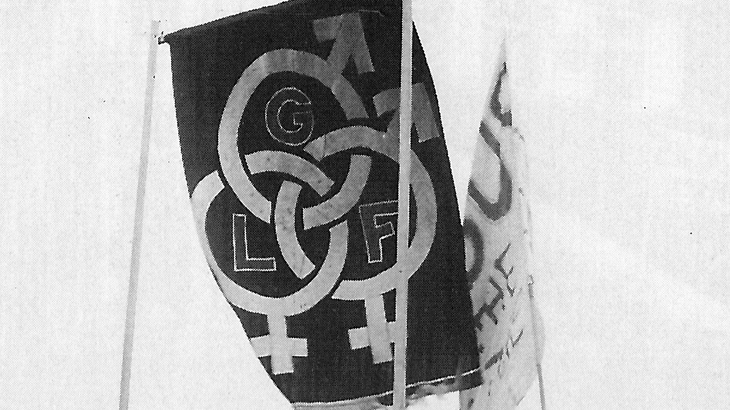
The UK Gay Liberation Front was founded by Aubrey Walter and Bob Mellor in 1970. Both had independently been associating with the New York GLF (the original Gay Liberation Front) during the summer that year and had subsequently met in America at The Revolutionary People’s Constitutional Convention. The RPCC had been organised by the Black Panthers and was attended by numerous groups including the GLF.
The first meeting was held at the London School of Economics, of which Bob Mellor was a student, on 13th October 1970. On 27th November, they would hold their first public demonstration, the first in the UK by lesbians and gay men, in Islington to protest against “pretty policemen”- male officers who were sent into toilets and parks in order to lure gay men into committing offences and then arresting them. Whilst it was not illegal to be gay, certain activities were. The 150 strong protest had been sparked by the case of Louis Eakes, who had been found guilty of gross indecency, naming importuning which essentially just required a gay man to be flirtatious or even just friendly with another man to be arrested. Eakes, a member of the Young Liberals, claimed he was heterosexual and had been looking for a light for a cigarette. The event was commemorated with a plaque on the 30th anniversary of the protest.

It was also in 1970 that they began publishing their newspaper, Come Together, which ran for a total of 16 editions. They also formed numerous groups to focus on specific issues including an anti-psychiatry group, a women’s group and a youth group. By December they had agreed on their Demands & Principles and a month later in January 1971 they would hold Think Ins which established the three rules of the movement.
“1. No-one could serve on the Steering Committee for more than two months.
2. Heterosexuals could not serve on the Steering Committee
3. No one could serve on the office collective for more than three months.”
In August member of the GLF Youth Group organised a protest against the inequalities between the age of consent laws. For heterosexuals the age of consent was 16 but for gay men it was 21, with women not even being mentioned. The demonstration began at Hyde Park with a march through central London to their end point at Trafalgar Square.
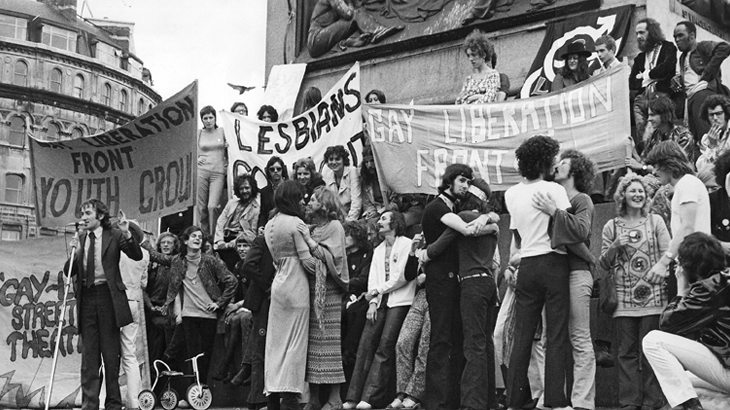
In September 1971 they held their most successful action Operation Rupert – the disruption of the Festival of Light. It was a campaign organised by British Christians and was led by notable people such as Mary Whitehouse and Cliff Richard. Its purpose was to oppose what they saw as increasing sexual and violent themes on TV as well as concern about growing acceptance of homosexuality, abortion and extra-marital sex. The GLF disrupted their first meeting by invading dressed in drag, releasing mice, sounding horns and sending a team dressed as workers to enter the basement and switch off all the lights.
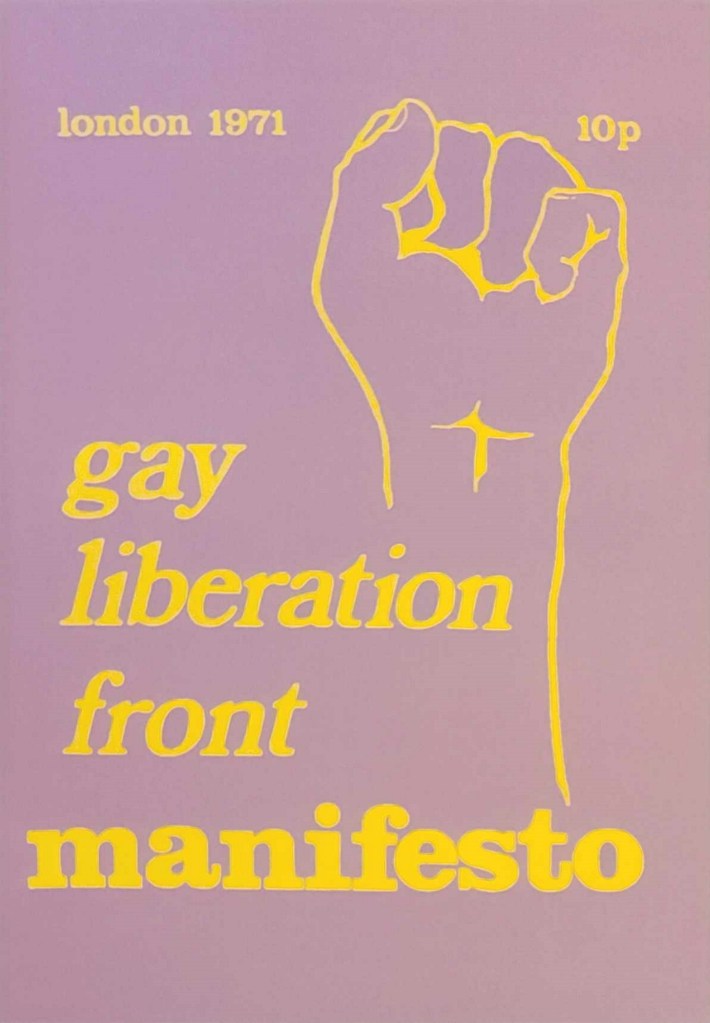
In October, one year from their founding, they released their manifesto. The manifesto detailed the ways in which gay people were oppressed through the law, violence, religion and gender norms. It also included a list of their demands alongside the work they had already done in the name of gay liberation. The manifesto has been reprinted several times with the 1979 edition being a revised copy which emitted or rewrote some sections.
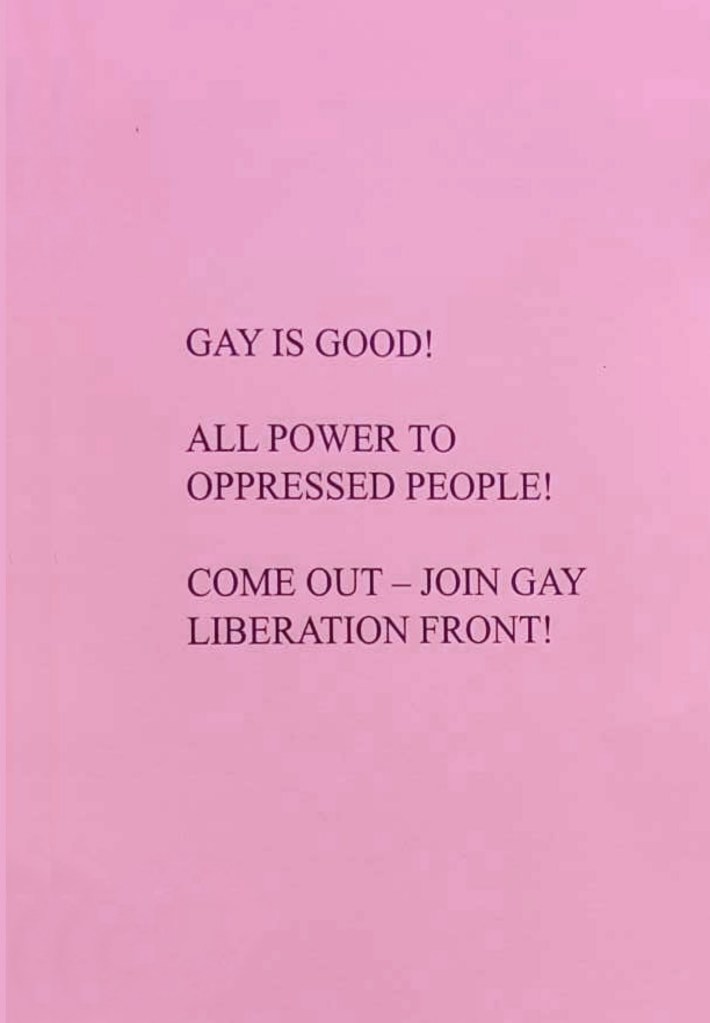
By the end of 1971 however, the group had begun the splinter. There were arguments over ideology and how best to work. The GLF already challenged norms and several believed challenging ideals of masculinity was a necessary step, some disagreed and were single-issue gay men who ignored the groups manifesto. Several smaller groups formed within London starting with the Camden GLF. The Women’s Group had also been unhappy with the wider group and eventually became involved with other women’s liberation groups, including attending a national conference where they took to the stage to talk about being lesbians in reaction to how the conference was being run.
In February 1972, the Women’s Group decided to formally leave the GLF due to the sexism they faced from their male counterparts. By April, the all-London meetings had ceased in favour of the smaller local groups, partially due to the split between the remaining men. Despite spending 1972 hosting their first National Conference in March and organising the first UK Gay Pride in July, the conflict between the two groups of men remained. By the end of 1973, the UK GLF had totally collapsed.
This was not the end as individual groups continued to act. Notably, the South London GLF stood candidates in both local and general elections in 1974. That same year they would squat 78 Railton Road and turn it into the South London Gay Community Centre, the first gay centre in the UK.

As of today, the legacy of the Gay Liberation Front in the UK is vast. From out of the ashes of the GLF several organisations formed including OutRage!, Gay Men’s Press and the London Gay Switchboard (now just called Switchboard). We even have the Sussex GLF to thank for Brighton’s first Pride. It’s also worth noting that many of the members are still alive and active in our community today. Even the words of their manifesto still resonate with much of our community over 50 years later and is a short but worthwhile read for anyone interested in the group or simply in becoming active in gay liberation. A 50th edition reprint of the manifesto is available from numerous retailers, including our oldest LGBT bookshop Gay’s The Word, with online copies of the original 1971 edition and 1979 revised edition available freely from the Bishopsgate Institute.
While our events are primarily social, the organisers at NLS have committed to using our platform to further social change in a political climate that has become increasingly hostile to our community and women in general. Part of this is learning from other groups who have come before while continuing their fight in the face of opposition. You may have seen our involvement with UKWM earlier this year and our subsequent efforts in creating Women’s Alliance Northampton. As such, this month felt like a great time to talk about a topic close to our heart. This has been just a simple overview of one group in our history and we hope it serves as inspiration for others to get involved in activism of their own, however minor the work may feel.
Manifesto Links:
GLF Manifesto 1971 edition pdf >here<
GLF Manifesto 1979 edition pdf >here<
50th anniversary edition from Gays the Word >here<

 Northants Lesbian Society
Leave a comment